


Large-scale Water Storage for Australia's Data Centres
Engineered, scalable water storage that secures cooling supply, protects a scarce resource and keeps critical digital infrastructure running: sized to your load and built close to your site.
15+
YEARS OF CONTAINMENT EXPERIENCE
400+
CONCEPT TANKS INSTALLED ACROSS AUSTRALIA AND NORTH AMERICA
1ML-78ML
MODULAR TANK
CAPACITY RANGE
Built for Data Centre Water and
Cooling Management
Australia is one of the world's fastest‑growing data centre markets, with more than 250 facilities in operation and hyperscale and AI campuses expanding across major cities and regional corridors. Rising rack densities mean more heat to reject, and many operators rely on evaporative cooling towers and adiabatic systems to do it efficiently. [ABC News: Data centre water use in Australia]
Evaporative cooling is energy‑efficient but water‑intensive: around 80% of the water drawn is lost to evaporation, with the remainder discharged as concentrated blowdown. Water now sits alongside power as a critical utility, and the Australian Government expects developers to show how supply will be secured. [WSAA: Data Centres and Water in Australia] [DISR: National Data Centre Expectations]
What data centre operators
are facing

Rapid Demand Growth
Sydney Water forecasts data centre demand could reach around 15–20% of Sydney's supply by 2035, up from less than 1% today. WSAA: Data Centres and Water in Australia, Sydney Water: Data centres

Continuity of Cooling Supply
Mains interruptions, network constraints or drought restrictions put uptime at risk. Utilities expect operators to plan on‑site storage, and Commonwealth expectations call for resilience to drought and climate disruption.
DISR: National Data Centre Expectations

Shift to Recycled Water
Government and utilities are directing large users to non‑potable sources, which require buffer storage between treatment plant output and cooling demand.
Greater Western Water: Melton recycled water connection

Peak Demand in Extreme Heat
Cooling load peaks on the hottest days, when networks are most stressed, and extreme heat events are projected to become more frequent. Developers must now state peak demand and drought contingency at approval. CSIRO & BoM: State of the Climate, University of Melbourne: Pursuit

Blowdown Compliance
Blowdown concentrates salts and dissolved solids, and trade waste limits on temperature, salinity and pH require staging before treatment, reuse or discharge.

Water Efficiency Scrutiny
National Australian Built Environment Rating System (NABERS) is developing a national water efficiency framework for data centres, and Commonwealth expectations call for transparent water reporting, making every avoidable litre of loss, including evaporation from open storage, a reportable inefficiency.
WSAA: NABERS water framework
Typical data centre applications
Cooling tower make‑up water
Raw, treated or recycled water storage for cooling autonomy during supply interruptions.
Recycled and harvested water buffering
Balancing recycled, stormwater or roof‑water supply against cooling demand.
Peak‑day and drought resilience
Off‑peak filling to carry heatwave loads and reduce reliance on network capacity.
Blowdown equalization
Compliant containment ahead of treatment, reuse or trade waste discharge.
Fire water reserves
Large‑volume storage engineered to site fire requirements.
Construction and commissioning water
Rapidly deployed storage for dust suppression, hydrotesting and flushing during build‑out.
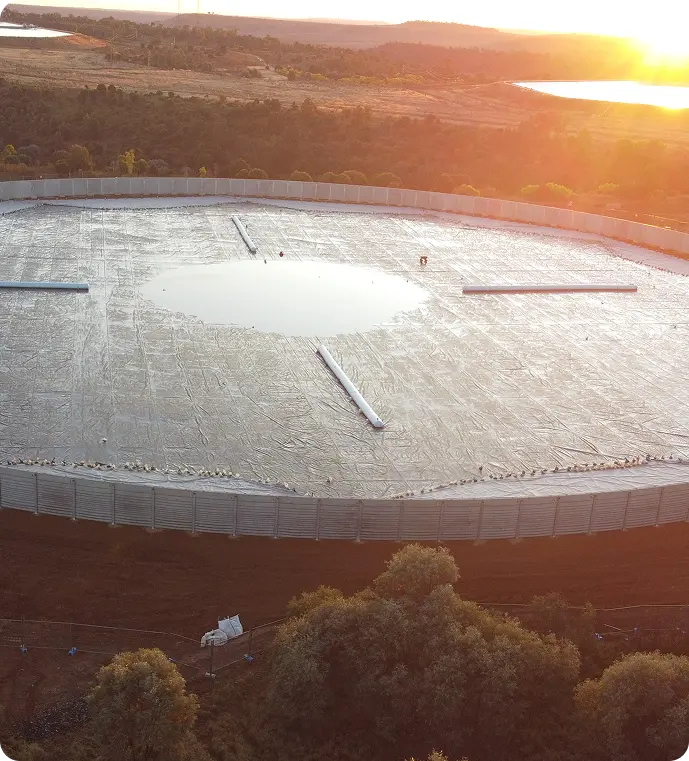
Concept Tanks Data Centre Water Storage Solutions
Concept Tanks delivers a new class of storage infrastructure: engineered, above‑ground water storage proven across mining, energy, and utilities. Drawing on our full range, including the Concept Tank™ and Concept AST™ product lines, we tailor each solution to the campus's cooling architecture, program, and growth plan, from the first data hall to full campus capacity, using locally sourced materials in each market we serve.
- Geomembrane liner systems tailored to fluid chemistry and service life, including raw, treated and recycled water and concentrated blowdown
- Full quality assurance and quality control (QA/QC) from manufacture through installation and commissioning, by our in-house liner team
- Leak Detection Systems (LDS) as standard, detecting a leak before it reaches grade
- Engineered Floating Covers (EFC) available as an add-on in an evaporation prevention configuration, also preventing algae and controlling rainfall and debris ingress
- Custom pipework configuration as standard, with overflow weirs and anti-climb protection available as add-ons to suit site layout and security requirements
- Above‑ground structures with reduced civil scope compared with in‑ground or cast‑in‑situ concrete storage.
- Locally sourced materials and in‑house manufacturing, with installation in days to weeks after civil pad preparation, aligned to fast‑track data centre programs.
- Optional supervisory control and data acquisition (SCADA) system and remote monitoring (levels, LDS alarms, weather), including solar‑satellite telemetry.
- In‑service support: clean‑outs, relines, relocations, reuse/repurpose.
- Modular circular tanks from 1ML to 78ML and higher across our range.
- Diameter and wall height configured independently to meet precise volume and footprint targets.
- Scale with each data hall or campus stage, or reconfigure (larger/smaller) using existing structure: no‑regret spend supporting circular infrastructure objectives.
- Relocate as site layout, water sources or cooling technology change.
Cooling towers consume water by design. Storage should not. Concept Tanks Engineered Floating Covers provide total surface coverage of stored water, controlling evaporation, blocking sunlight to prevent algae and duckweed, reducing disinfectant demand and keeping rainfall and debris out. The water you secure is the water you use.
- The Concept AST™ is available to buy, rent, or rent with a buy-out option. The Concept Tank™ is available to buy, as a long-term rental, or as a long-term rental with a buy-out option.
Systems and add-ons at a glance
Tailored from our range: a quick comparison of the tanks we recommend for data centre water storage, so operators can match the right configuration to their site requirements. Both product lines share our certified liner systems, in‑house QA/QC and standard Leak Detection Systems.
|
Concept Tank™
Explore the Concept Tank™ ↗ |
Concept AST™
Explore the Concept AST↗ |
|
| Capacity per tank | 1ML – 78ML | 0.6ML–14.5ML |
| Construction | Precast concrete panels, post‑tensioned cable system | Prefabricated steel panels, bolted on site |
| Structural design life | 25-years+ (on condition) | Up to 5 years (on condition) |
| Installation | 1–7 weeks after civil pad preparation | 1–6 days after civil pad preparation |
| Best For | Permanent campus storage: make‑up water, recycled water buffering, drought and fire reserves | Construction and commissioning water, interim capacity during staged build‑out, rapid redeployment |
Key inclusions and add-ons
EFC
Engineered Floating Cover
Engineered geosynthetic barrier used to prevent ingress of rain, cross contamination and prevent evaporation. We engineer and configure covers to your need to prevent excess generation and/or evaporation.
LDS
Leak Detection System
Monitors the interstitial void between primary and secondary liners, giving early warning of a potential primary-liner breach. Powered using a solar battery backup or mains power connection, our LDS services any site no matter how remote.
MONITORING
Remote Monitoring
Remote monitoring connects the system and LDS to your site supervisory control and data acquisition (SCADA) system or telemetry for remote visibility and alarm response.
PIPEWORK
Custom Pipework
Connecting the storage solution to your infrastructure pipework is configured to your needs, including under, over, or through wall penetrations, as well as flanges, valves and vortex breakers.
Frequently asked
questions
Can storage grow with each data hall?
Yes. Tanks scale with each data hall or campus stage, or reconfigure (larger/smaller) using the existing structure. They can also be relocated as site layout, water sources or cooling technology change.
How do you reduce evaporation from stored cooling water?
Engineered Floating Covers provide total surface coverage of stored water, controlling evaporation, blocking sunlight to prevent algae and duckweed, reducing disinfectant and keeping rainfall and debris out.
Can you store recycled water and blowdown?
Yes. Geomembrane liner systems are tailored to fluid chemistry and service life, including raw, and recycled water and concentrated blowdown, with a Leak Detection System as standard.
How quickly can storage be installed?
A Concept AST™ installs in 1–6 days and a Concept Tank™ in 1–7 weeks, both after civil pad preparation.
Can we rent instead of buying?
The Concept AST™ is available to buy, rent, or rent with a buy-out. The Concept Tank™ is available to buy, as a long-term rental, or as a long-term rental with a buy-out.
Need a data centre water
storage solution?
Every data centre campus has different cooling and storage requirements. Contact us to speak with our data centre water specialists to discuss tailored solutions that will suit your application and needs.